Tuesday, December 7, 2010

Visual Aids for My (Rolando's) Presentation

Stuff and Fluff

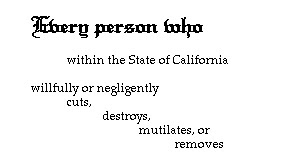
Exhibit A: The Alphabet that Thinks

Exhibit B: California Law Code on Not Touching Trees
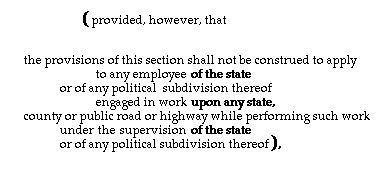
Every person who within the State of California willfully or negligently cuts, destroys, mutilates, or removes any tree or shrub, or fern or herb or bulb or cactus or flower, or huckleberry or redwood greens, or portion of any tree or shrub, or fern or herb or bulb or cactus or flower, or huckleberry or redwood greens, growing upon state or country highway rights-of-way, or who removes leaf mold thereon; provided, however, that the provisions of this section shall not be construed to apply to any employee of the state or of any political subdivision thereof engaged in work upon any state, county or public road or highway while performing such work under the supervision of the state or of any political subdivision thereof, and every person who willfully or negligently cuts, destroys, mutilates, or removes any tree or shrub, or fern or herb or bulb or cactus or flower, or huckleberry or redwood greens, or portion of any tree or shrub, or fern or herb or bulb or cactus or flower, or huckleberry or redwood greens, growing upon public land or upon land not his own, or leaf mold on the surface of public land, or upon land not his own, without a written permit from the owner of the land signed by such owner or his authorized agent, and every person who knowingly sells, offers, or exposes for sale, or transports for sale, any tree or shrub, or fern or herb or bulb or cactus or flower, or huckleberry or redwood greens, or portion of any tree or shrub, or fern or herb or bulb or cactus or flower, or huckleberry or redwood greens, or huckleberry or redwood greens, or leaf mold, so cut or removed from state or country highway rights-of-way, or removed from public land or from land not owned by the person who cut or removed the same without written permit from the owner of the land, signed by such owner or his authorized agent, shall be guilty of a misdemeanor and upon conviction thereof shall be punished by a fine of not more than five hundred dollars ($500) or by imprisonment in a county jail for not more than six months or by both such fine and imprisonment.


Exhibit C: Code Presented in "Thinking Alphabet"


Martin Heidegger argued that typewriters destroyed handwriting, and Plato argued that writing destroyed speech. But Lanham argues that digital expression renovates speech in writing. It invigorates writing. It makes writing more like speech.

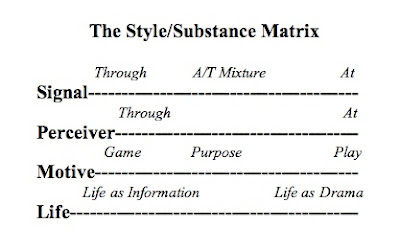
Exhibit D: The Style/Substance Matrix

Exhibit E: The (False?) "Assumptions" about Higher Education

1. The Ideal Education is Face-to-Face, One-to-One

No. Blogs have disproved that.

2. Higher Ed., in its ideal form, is performed sequestered from time and space.

But virtual ed. allows us to flow between both. Besides, when we're in college, we crave for real-world experience (extra-curricular activities, etc.).

3 & 4: The Tenure System is Good & The Univ. Protects its Faculty from "Outside World"

"A lifetime of protection makes for an eternal childhood."

Professors should be given money according to their popularity (and this happens in virtual ed). Plus, lots of classes makes for tedium. Wouldn't you like for your course to be given online, so there's less of it?

6: University Faculties are animated by a purity of motive different from, and superior to, the world of ordinary human work.

Oh Plz!

Univ's need to wake up and smell the fresh attention-driven roses of the attention economy.

Monday, December 6, 2010

http://www.nybooks.com/articles/archives/2010/nov/25/generation-why/?page=2

This link is to Zadie Smith's recent article ("Generation Why") in the New York Times Review of Books. It's very insightful and provocative. She discusses the implications of Facebook and much more. It immediately inspired me to remove a lot of excess personal data on my profile and has given me a lot to think about in my interaction on the site.

Jonas

Wednesday, December 1, 2010

Like parent like child

One of the presentation actually reminded me of a ABC television show called "Modern Family". This season there is an episode that addresses the issues (and humor) of being "disconnected".

Upset that the children are too obsessed with their technology, Claire (the mother) decides to teach them a lesson. Her and her husband, Phil, set up a game in which the entire family has to go without technology. This includes cell phones, lab tops, televisions etc. The challenge pits parents versus children in a battle of endurance: Who can stay disconnected the longest?

Here is the link to the episode: Unplugged


Not for the college student

http://techcrunch.com/2010/11/30/why-the-kindle-is-losing-me/?utm_source=feedburner&utm_medium=feed&utm_campaign=Feed%3A+Techcrunch+%28TechCrunch%29

This is a pretty cool article about why some e-readers especially the kindle can actually pretty detrimental to the college student... It is pointed out the hinderances and what could improve... Pretty interesting.

Tuesday, November 30, 2010

Wednesday, November 17, 2010

A Note On Notes

The other day, I took notes on my iPad for the first time.

I know, I know - I'm super late to the party. I feel like that might have been the first thing most people in this class did with their iPad, what with the whole "let's try to integrate these things into our academic lives" thing that we were all so excited about at the beginning of the class.

But I, with my eternally stubborn tendencies, couldn't do it. I am a writer. When I take notes, I write. I enjoy the physical feeling of writing - the movement of my hand, the pen sliding smoothly over the page - almost as much as I enjoy what I write. I like my handwriting. A lot of the time, I write down nonsense just to feel myself write the way some people tall just to hear themselves talk. Taking notes is the perfect outlet for that - I have an excuse to write endlessly for an entire class period without stopping. It doesn't really matter if I'm interested in the material or not; I just love taking notes. I know, it's weird. It might be just a vanity thing. Whatever. What I'm trying to say is, from the very outset of this class, I was determined not to let the iPad take away the joy of note-taking from me.

After Timothy Morton came to class two weeks ago, though, I found myself thinking about the iPad differently. He talked about his use of it with his students and the use of it in his personal life, and seemed to be largely singing praise of it - why should we renounce something, he seemed to be getting at, that is so clearly intended to be used for our convenience, so clearly intended to make academic life (and indeed home and work life) so much simpler and quicker?

On Wednesdays, after this class, I have another class with Dr. Schaberg and that particular day, Timothy Morton made an appearance in that class as well. Perhaps it was an attempt to impress him or something, I don't know, but I decided to take my iPad out and take my class notes on it - just for one day.

My fingers didn't stop moving for the entire class. I found that I was able to type pretty much as fast as people in the classwork were talking - an approach I usually attempt with my handwritten notes, but at which I rarely succeed. I felt I was able to type on the iPad even faster than I would on my own laptop. This was especially curious to me. I spend a good chunk of every day on my laptop, and have done so since I got it in high school, so I assumed that my extensive "training" there would make it the instrument on I'd find myself most efficient. Not so. Maybe it's because I don't have to press any keys down, or because I've become adjusted to the iPad's autocorrect and therefore pay less attention to what I'm typing, but I'm like a damn speed racer on this thing. As a result, I found when going over my notes that there was a much more comprehensive representation of what had gone on in class, and I found myself recalling and even understanding better the discussion we'd had, as opposed to looking at scattered half-sentences and marginal notes and trying to remember what I meant by them.

Even in the face of all that, though, I'm still not convinced. An aspect of taking my notes on the iPad that really irked me was the fact that my notes were suddenly separate from my readings. I like to take excessive notes in my books. It's visually easier for me that way to link together thoughts I have with specific areas of the text. Not only that, but over the years I've developed a pretty intricate system of underlinings and markings to indicate specific relationships, linkages and auxiliary thoughts of mine in relation to a text. With notes on the iPad, that disappears - it's just a block of text, arbitrarily organized by thoughts as I have them, and I have to have the iPad set out alongside my book, attempting to pinpoint which notes belong to which sections instead of just having them integrated into the text itself.

For now, I'm working on finding a balance between the convenience and the comfort. Much to my own surprise I've continued use of the iPad as a place for note taking, but I still mark up my books just as heavily as before. The iPad doesn't come out while I'm reading, but instead during class discussions where I can create a separate space for the topics we discuss there. It's not flawless yet, but I feel I might be making some progress. Let's go future! Full steam ahead!

Electronic Literature Links

Hey all! These are the links and videos that conveniently didn't work in class today. I think that they are integral to understanding the murky nature of electronic literature though, and strongly suggest you explore it for yourself.

E-Literature Explained
http://www.youtube.com/watch?v=GOihjPnq_A4

ELO
http://www.eliterature.org

David Knoebel's "Heart Pole"
http://home.ptd.net/~clkpoet/htpl/index.html

Wednesday, November 10, 2010

Class Notes, 10 November

Schaberg: Now is when we really start to hone in on the questions / issues to focus on for next semester. For books reports: if there is a part of your book you thin would be useful to read as a class, please share.

Jeffrey's Presentation:

App "Two Screens": Presentation app that allows you to open powerpoints and PDFs at the same time

"The Dumbest Generation: Don't Trust Anyone Under 30": premise of book - we're dumber than we've ever been. Young people are more likely to know the American Idol than the Speaker of the House. Deficiencies are across the board in all subjects.

Between 1992 and 2002 literacy rates have decreased in all areas: age, race, gender, education. Judgement based on whether you have read anything literary in the past 12 months - includes basically anything (poems, magazines, song lyrics)

"The abundant material progress has not just disengaged today's use, it has hindered it." We have more readily available knowledge than ever before but we choose not to utilize it. 43% of 18-24 year olds considered themselves readers outside of school in 2002. In 1946, that figure was 92%.

"Harry Potter has not sparked an invigoration of reading." After the last Harry Potter book was published, sales of children's books went down 43 million units.

"The Dumbest Generation will cease being dumb only when it regards adolescence as an inferior realm of petty strivings and adulthood as a realm of civic, historical and cultural awareness that puts them in touch with perennial ideas.." - there is a generation of people trapped in adolescence called Twixters.

Interview with Bauerlein: Digital culture doesn't mean access to knowledge for teens, it means access to each other. 9/10 of the to websites are social networking sites. Our leisure activites: 95% of us watch an hour of tv a day; we don't go to museums, we don't patronize the performing arts. Out of the 31% of adults who said they read, 16% of them did not read literature.

What do we do? Adults should stop kids from watching tv, listening to iPod during homework, tweeting, etc. There is going to be a record of our behavior and we need to take preventative measures so that we're not the ones who abandon learning and education.

Our culture is "aliterate" - we can read, but we don't.

"Reading at Risk" survey can be found on the website for the National Endowment for the Arts - should be read, it's really interesting.

Thoughts from the class:

Statistics from the book may not be accurate because standardized tests are very flawed.

All the school system does is prepare you for standardized tests, not any kind of real learning.

Every generation thinks that the generation after them is dumber - is it pointless to make these claims? Shouldn't we focus on what we do know instead of what we don't?

The book is kind of pandering - a book about people who don't read so that people who do will read it and congratulate themselves.

Monday, November 8, 2010

Hamlet On Facebook

Well, whaddaya know! The idea from the "Deep/Hyper Attention" article has already humorously been put into practice by folks at McSweeney's. Here it is, Hamlet on FB:

HAMLET
(FACEBOOK NEWS
FEED EDITION).

BY SARAH SCHMELLING

- - - -

Horatio thinks he saw a ghost.

Hamlet thinks it's annoying when your uncle marries your mother right after your dad dies.

The king thinks Hamlet's annoying.

Laertes thinks Ophelia can do better.

Hamlet's father is now a zombie.

- - - -

The king poked the queen.

The queen poked the king back.

Hamlet and the queen are no longer friends.

Marcellus is pretty sure something's rotten around here.

Hamlet became a fan of daggers.

- - - -

Polonius says Hamlet's crazy ... crazy in love!

Rosencrantz, Guildenstern, and Hamlet are now friends.

Hamlet wonders if he should continue to exist. Or not.

Hamlet thinks Ophelia might be happier in a convent.

Ophelia removed "moody princes" from her interests.

Hamlet posted an event: A Play That's Totally Fictional and In No Way About My Family

The king commented on Hamlet's play: "What is wrong with you?"

Polonius thinks this curtain looks like a good thing to hide behind.

Polonius is no longer online.

- - - -

Hamlet added England to the Places I've Been application.

The queen is worried about Ophelia.

Ophelia loves flowers. Flowers flowers flowers flowers flowers. Oh, look, a river.

Ophelia joined the group Maidens Who Don't Float.

Laertes wonders what the hell happened while he was gone.

- - - -

The king sent Hamlet a goblet of wine.

The queen likes wine!

The king likes ... oh crap.

The queen, the king, Laertes, and Hamlet are now zombies.

Horatio says well that was tragic.

Fortinbras, Prince of Norway, says yes, tragic. We'll take it from here.

Denmark is now Norwegian.

http://www.mcsweeneys.net/2008/7/30schmelling.html

Sunday, November 7, 2010

Things I do instead of homework

I made this after the Hyper attention vs. Deep attention article. The text is probably hard to read. Sorry about that. =/
The dialogue goes like this:
Purple hair girl: "I'm downloading a playlist of fight songs, texting my mom, and googling fighting techniques!"
Orange hair girl: "I'm making a Pro-Hyper Attention blog, tweeting, and posting pictures of our robot on Facebook!"
Blue hair boy: "I Wikipediaed robots and spent like 2 hours watching Youtube videos of how to build robots before I started building, so this robot should be pretty good. I hope this universal remote works...This button either turns on the robot or opens my garage..."
Robot: "PREPARE TO DIE!"
Deep attention guy: "I've been studying the art of sword fighting since age 2. I have spend 14 hours of every day of the last 87 years sword fighting. I have 2 PhDs in sword fighting. I also love this sword more than I love my wife. Now, prepare to die!"

Wednesday, November 3, 2010

In Digital Age, Students Still Cling to Paper Textbooks

http://www.nytimes.com/2010/10/20/nyregion/20textbooks.html?_r=1

The link above is certainly relevant for our class!

Thoughts on Last Week's Discussion & Intro. to "The Ecological Thought"

Our discussion last week on hyper/deep attention prompted in me the question: why do we learn? Or for teachers: why do they teach? In other words: what is the purpose of teaching? I realize that this may seem like a silly question, one to which the answer begins with: "Obviously..." But, in light of our discussions, I think it's important to keep in mind the goal of education, in order to see how ways of learning, ways of "paying attention," can drive us to or disorient us from that goal. Let's see Loyola's Mission Statement:

Loyola University New Orleans, a Jesuit and Catholic institution of higher education, . . . prepares [students] to lead meaningful lives with and for others; to pursue truth, wisdom, and virtue; and to work for a more just world . . . Through teaching, research, creative activities, and service, the faculty, in cooperation with the staff, strives to educate the whole student and to benefit the larger community.


So it involves a pursuit of truth and a sort of rite to be a person "with and for others," as Ignatian teaching says. Perhaps here Morton's notion of Ecological Thought gains relevance, because in this sense of learning to be in the world, then we do need think in terms of interconnection with others, both human and nonhuman, "think ecologically."

Well. How do hyper/deep attention and education relate to the iPad, and how does the iPad relate to "the" ecological thought? I'm still thinking about it. But I can see a relationship... I just can't quite see its inner dynamics of it yet.


Tuesday, October 26, 2010

A book that is an app

There is a new app that is both a digital copy of Stephen Elliott's book "The Adderall Diaries" and also a digital community and other expanded features. I see this as a direction that could be highly appealing to adders. Buy a book that comes with a book club. Thoughts? I will not say more because there is a much better crafted article about it in the NYT today.

Saturday, October 23, 2010

Place & space

I was just looking up an address on my iPhone, and glancing at the Google map, and I suddenly wondered: are digital humans in fact more geographically inclined or savvy than any humans before? I know we talk about computers keeping people from connecting with woods and so on, but by the way that digital humans can read maps so quickly, are we in a funny way more than ever tuned into actual, physical space? What does it mean that we can map space so (seemingly) effortlessly? Does the ability to navigate a Google map mean that we know the space that our bodies then move through? These are roughly hewn questions; help me out with this.

Thursday, October 21, 2010

Down

I think yesterday's conversation went really well, and I would like to extend it here, if I may. (Because I haven't been repeatedly encouraged to post here, or anything.)

I've been thinking a lot about the difference between the internet and physical places. One of the themes which has arisen frequently in class lately is the very basic idea that physical places have maps. This is interesting, I think, when applied to the internet, because, while the internet is a series of pages, or rooms-- while the locations are divided into (usually) reasonable portions, as in Borges' library-- it is impossible to map a two-dimensional representation of those rooms-- at least, not without some spectacular innovation. And this is because there is no down. There is absolutely no orientation. Actually, I'm about to contradict myself. There is orientation. It just isn't up or down. Maybe I should think larger. Maybe the internet is less like the surface of the earth, something that can be mapped two-dimensionally, and more like outer space.

Because the closest things we have to orientation on the internet are these, what shall we call them, these points of convergence-- there is a better word for this, I know it-- where a lot of trails on the internet will lead. Wikipedia, for instance, is a cluster of articles, all of which are closely interlinked, and if you Google search any given term the Wikipedia article for said term will be sure to top the list because so many people link to Wikipedia every day. It's common practice in the blogosphere, when referring to something of which people may or may not be aware, to link to the Wikipedia article, so they can explore the topic at their leisure along with any adjacent and relevant topics which they made find interesting. So Wikipedia is an enormous-- I want to use the word fulcrum, but that isn't it-- point of convergence, as is Facebook. Most major sites would act as points of convergence, and this is the closest thing we have to orientation, because these points of convergence exert a sort of gravitational pull-- the larger a site is the more likely one is to link to it or to utilize it as a reference. So the closest thing I have to a map of the internet in my head is this enormous sphere, because I have to make it some sort of limited shape and I like spheres, with thousands of different, hair-thin, almost imperceptible links stretching from one place to another and converging in densely-packed planetlike structures. What I'm doing with this in my head, and this is entirely arbitrary-- I'm making the links silver on a black background, and as I've said they're hair thin, so you can't see them unless they intersect rather a lot. And because a point of intersection has to be fairly densely packed to be seen, the information-masses are scattered across the blackness, like stars. And as links are constantly made, shifted, and broken, the map changes and grows.

This is fanciful on my part, but probably the most realistic thing one could devise which would act as a map to the internet would be something like Google or Bing-- sites which orient you by helping you find areas with the greatest gravitational pull. I am trying desperately not to compare Google to the North Star because at some point this will just become ridiculous. I'm going to end this here.

Tuesday, October 12, 2010

The Obstructionist

After reading Barry Lopez's "The Mappist," I began to think about my own habits in comparison to Corlis Benefideo's "comprehensive" but not "quick" enough way of operating. The story filled me up with all of these arguments and counter-arguments about technology and the fastest, most convenient way to do things versus the most personal, detailed way. Ever since I received the iPad, I've found myself more and more confused about what the "right" or most efficient way of doing things really is. I've often found myself wondering, "How much is this piece of technology really helping me? Sure, it consolidates my books and notebooks. I don't have to carry as many things around. I use less paper, but is it really making my life easier?"

I know that the iPad and other devices like it (eReader, netbooks, etc.) are supposed to be advancements in technology, designed to make people's lives easier, bit in a lot of ways, my life has become more challenging because I'm trying so hard to incorporate this piece of technology into my routine. I've found that in doing so, I've had to rework and/or delete many of the habits that help me function on a day to day basis. For example, I can no longer doodle when I take notes if I want to do it on the iPad. I've scoured the app store looking for something that will simulate a blank notebook which I could easily type notes and doodle on, but I've found nothing. The apps that I have found for just doodling (I've tried out 3 different ones) are really more like the "Paint" program on a computer than drawing on paper. As much as I've practiced, I still find it incredibly difficult to draw or even to write legibly on the iPad (or with the "Paint" program). I spent the entire hour of last class trying to sketch a really simple doodle of our classroom, something that would have taken maybe 5 minutes with pen and paper, and by the end of class, I still hadn't figured out how to make the tables proportionate to each other. For the first few weeks of school, I took notes in all of my classes with the iPad "Chapters" app, which allows for typing in a variety of fonts but not doodling. Around maybe week three, a sketchbook somehow snuck into my bookbag, and my inner doodler had this kind of vicious awakening where I didn't take notes at all for about two days and instead I just doodled throughout all of my classes. At this point, I'm trying to strike a balance to appease my inner doodler and to make use of the iPad. In classes where the teachers draw a lot of charts, I write my notes by hand because it's really difficult to draw a chart on the iPad without having to import it from one program to another. In classes where the teacher talks really fast, I use the iPad because it's faster for me to type than to write.

In a lot of ways, I sympathize with Corlis Benefideo, especially when he is labelled "an obstructionist," because I feel like in a lot of ways I am my own obstructionist; the habits that are ingrained into me get in the way of my ability to surrender to this faster, more convenient way of doing things.

I am an avid list-maker. I got the "Easy Task" app, which allowed me to put all of my homework assignments, chores, and whatever else I felt the need to put in a to-do list into one space. It even allows me to rank the importance of each task on a scale of 1-5. For some reason, however, I have taken to writing to-do lists on my dresser in Sharpie, as well as programming them into the "Easy Task" app. There is something immensely satisfying for me about crossing items off a tangible to-do list that the "Easy Task" app just can't capture. Also, with all of these tasks written on a rather large piece of furniture in my room, anytime I'm in my room, I am accosted by this brightly colored list of things that I should be doing. The closest that the "Easy Task" app gets to grabbing my attention is a little red number that sometimes shows up to indicate the number of tasks that are due that day or that are overdue. As much as I've tried to train myself to perpetually monitor this app, some part of me apparently wants to be oblivious to what I am supposed to be doing because I haven't yet been able to get in the habit. Surprisingly enough, I don't carry my dresser around with me all day, and I do carry my iPad with me; so, the iPad is where all of these tasks are first recorded. I do find it convenient that I can just pull out my lightweight all-in-one to-do list/calendar/notebook/Internet source whenever I need to.

That being said, I get this terrifying crippled feeling whenever I'm in a place that doesn't have Wi-fi, and I feel an overwhelming need to check my email or look up facts about Pope Joan or Iceland or something. I swear, I think of more things that I need to do involving the Internet when I don't have access to it than I ever think of when I have no problem connecting. I'm probably not the only one who gets this sense of panic when the Internet is unavailable. I think that my generation, as a whole, is used to instant gratification, and when we don't get what we want as rapidly as we're used to, it's hard to handle.

Anyway, something else that struck me when I was reading this story was the amount of personal detail that went into Corlis's maps. He drew them meticulously by hand, with more intricate detail than any map of which I'm aware, and yet he lost his job as a cartographer for the government because he did not work quickly enough to appear bureaucratically valuable. Mr. Trevino was taken aback by the personal detail and "the soul" in Mr. Benefideo's work because he felt that it was so rare, a kind of lost art. I found this comparable to something that happened to me a few weeks ago. Facebook notified me that one of my friends (not a particularly close friend, just someone I'd had a few classes with) was having a birthday. I went to his Facebook wall to wish him a happy 20th but decided against it when I saw that his wall was already strewn with happy birthdays from his other 100 Facebook friends. Because this was during my doodling rampage, I decided to hand-make him a birthday card. I gave the card to him the next day in class, and he seemed confused but pleasantly surprised. At the end of class the thanked me for the card, saying that he really appreciated the personal touch, that none of his other friends had gotten or made him anything for his birthday, and that the card made his day because of that. I probably spent about 10 minutes making this card, which is maybe 9 1/2 minutes longer than I would have spent typing "Happy Birthday" in a Facebook post, but I think that the extra 9 1/2 minutes were worth it. The personal touch with birthday cards has been dying out for awhile, though, not just with Facebook posts but with the generic Hallmark happy birthdays before that. However, if all of the birthday boy's friends had taken the time to hand-make him birthday cards, my crappy card would not have been very special or meaningful. I really don't know what I would do if I got as many hand-made birthday cards every year on my birthday as I do wall posts... Wallpaper my kitchen with them? Save them forever in a shoebox in my closet? I don't know.

I also thought it was really interesting how much work Corlis put into studying the places before he actually created the maps. To other cartographers, it may have seemed like a lot of unnecessary work, but to Corlis the process was completely essential to the creation of his project, his vision. I identified because I go through similar processes before I write any big assignments. If I'm writing from a text, I always print the text and write all over it until all of my ideas are on the paper with the text (unless it's a book, then, if I own the book, I write in it, if not, I use a separate notebook or write lightly in pencil). Next, I write a very skeletal outline of what I want to say. After I've rewritten the outline several times with enough details added in, I start writing my paper, either by hand or on my typewriter. This forces me to re-type my work and thus re-read it, hopefully catching any errors and working out any clarity issues. That being said, it takes me a very long time to write things. It's probably not the most efficient way to do things, but for me, the process helps me to work through all of my ideas, to organize my thoughts, and to go through a series of revisions before I ever begin writing. In order to write this blog, I kind of condensed this process, but I can already tell that this blog isn't going to be as organized or concise as I would like it to be. It's already sort of stream-of-consciousness in some places...

I particularly liked the conclusion of the story because I felt like Corlis was talking directly to me when he was saying, "You represent a questing but lost generation of people... But the real question, now, is what will you do? ...don't make the mistake of thinking you, or I or anyone, knows how the world is meant to work. The world is a miracle, unfolding in this pitch dark." Really, it was this giant "aha!" moment for me where it felt like Lopez just reached out to me and said, "Holly, chill out. You're not doing anything wrong by using your iPad and pen and paper. There is no 'right' way to do things; do whatever feels most right to you." For some reason I've been really stressed out by trying to use the iPad whilst staying true to my own habits, as idiosyncratic as they may be. This story has reminded me that the iPad is really just an experiment. No one knows how the world is meant to work, and therefore, no one knows how we are meant to work in the world. I can decide whether using the iPad is right for me, but I can also choose to use a notebook, a computer, a typewriter, a planner, or yes, Robert, even a stone tablet, if something else works better for me.

(As an end note, I am typing this on my laptop [shame on me, I know] because when I try to type it on my iPad, the New Post screen will open, but it won't let me type anywhere other than the title box. It lets me highlight the page, and then it freezes. I don't know why I am having this problem, and Google doesn't seem to know, either, so for now, posting on my laptop is what's working for me.)

Final Presentations

This week, you are to choose one of the following titles. You will be responsible for reading this book and presenting a review to the class (perhaps utilizing an iPad app) at the end of this semester. Specifically, you should discuss how the book relates to our class discussions so far, and what the book offers us in terms of questions or problems that we might follow up on, next semester.

To 'claim' a book, leave a comment below this post with your choice.

Convergence Culture: Where Old and New Media Collide, Henry Jenkins

The Dumbest Generation, Mark Bauerlein

Technopoly: The Surrender of Culture to Technology, Neil Postman

The Culture of Narcissism, Christopher Lasch

The Shallows, Nicholas Carr

The Book is Dead (Long Live the Book), Sherman Young

From Gutenberg to Google: Electronic Representations of Literary Texts, Peter L. Shillingsburg

Writing Space: Computers, Hypertext, and the Remediation of Print, Jay David Bolter

Hamlet on the Holodeck: The Future of Narrative in Cyberspace, Janet Murray

The Economics of Attention: Style and Substance in the Age of Information, Richard Lanham

Electronic Literature: New Horizons for the Literary, N. Katherine Hayles

Hamlet's Blackberry: Hamlet's BlackBerry: A Practical Philosophy for Building a Good Life in the Digital Age, William Powers

The Late Age of Print: Everyday Book Culture from Consumerism to Control, Ted Striphas

Program or be Programmed: Ten Commands for a Digital Age, Douglas Rushkoff

Monday, October 11, 2010

BBB #2)

Sorry, I guess the test got a little bit messed up... but heres the link:

http://www.guardian.co.uk/books/2010/aug/04/barnes-and-noble-for-sale

Books, Banks, Buyers

Barnes and Noble bookstore chain put up for sale

Sad tale for US giant, which owns 720 high-street shops in all 50 American states but saw profits slump

America's largest chain of high-street bookshops, Barnes & Noble, last night put itself up for sale in the latest sign of distress in the literary retailing world which has already seen the demise of the Borders book chain in Britain.

B&N, which owns 720 high-street shops in all 50 American states, announced it was calling in the investment bank Lazard to advise on strategic alternatives including "a possible sale of the company" after a 45% slump in share price in the last year.

In common with other booksellers, B&N has struggled with changes in customers' habits. Readers are buying more books online, while digital readers such as Amazon's Kindle are rapidly becoming popular alternatives to traditional books.

Although B&N has digital and internet offerings including an electronic reading device called the Nook, three-quarters of its turnover still comes from bricks-and-mortar stores which suffered a 4.8% decline in like-for-like sales to $4.3bn in the year to May.

"A review of strategic alternatives is the appropriate next step to take full advantage of our compelling digital opportunities and to create value for shareholders, customers and employees," said B&N.

The chain's founder Leonard Riggio, who started the business with a bookstore in New York's Greenwich Village in 1965, immediately declared that he was a possible buyer, sending Barnes & Noble's share price up by 25% in unofficial after-hours trading on the New York Stock Exchange.

Riggio is B&N's biggest investor with a stake of almost 25%. But Riggio has come under criticism from an activist investor, billionaire Ron Burkle, over a deal in which he sold his family's chain of college bookstores last year to B&N for $514m – a price that Burkle claimed was excessive.

The rise of the online bookstore Amazon has caused trouble for high-street retailers for years and the recent economic slump has made matters worse. In Britain, the 45-strong Borders chain went bust late last year. The US version of Borders came close to bankruptcy but survived after a debt refinancing.James McQuivey, an analyst at research firm Forrester, said taking B&N private may allow Riggio, or another buyer, to make tough decisions outside the gaze of public markets.

"They might feel they want to buy the company back now and take it public later and reap the windfall," he said. "But there aren't a lot of investors who will be that certain about the probable outcome of that bet."

Sunday, October 10, 2010

Scribin' it up. 10/6/10

notes for ipad class: 10/6/10

Schaberg: we need to discover the path our course is taking, the goal we want to arrive at in the next few weeks

Schwartz: in last few weeks, we'll submit paper syllabus for next semester

Schaberg: let's hear from each of us, where would we like to go? what have we learned or want to learn?

Schwartz: utilize blog--very empty. formulate idea of what we're talking about.

schaberg: aphoristically! Each experience is different, expand on yours.

Rolando: wtf is up withevernote?

Bell: Mccay is using class login to post stuff, not her personal one.

Mccay: OHH SHIT. I'll get on that. How do I do it?

Schaberg, bell: ever note world. log out then log back in again.

Schwartz: satellite thing. I'll show you later.

Bell: Utilize blog, so much potential, we have limited class time, so use that space and don't let it go to waste. Ex: Borges.

Holly: I was confused, posted about it... maybe I was wrong, cause no one else did it.

Bell: wahhhh. nope, use it. not even as an assignment, but as a space to talk about it. Have no fear! use it! don't wait or hesitate.

Bell: Well what'd you think of the story?

Holly: was it a story?

everyone: pshh yeah. what'd you think it was.

holly: I was confused. I printed it out.

Schwartz: interesting that in discomfort, you printed it.

kalee: I was all wahhh!

Bell: Story was a bad word. "Text" maybe? He's even toying with the idea of "what is a story?"

Schwartz: why did you think we asked you to read it? did it relate?

rolando: I can think of one. anticipated information age on the part of borges. he mentions the suicides, etc influenced by the overpopulation of information. Search for the ONE BOOK. Though there is no evidence...

Schwartz: well in such a library, there must be such a book, right? parallel.

Amelie: there's got to be books that claim that they're that book.

everyone: right, yep.

Jeffrey: but then every book cancels everything else out, if so.

Schaberg: pyramid shaped e-book. Problem: in principle, infinite regress into informatic levels

Chris: the one book as a cipher, that will clear up all misinformation?

Schaberg: like dictionary definitions! think you're getting exact definition, but more than one may f/ with you.... cereal box mirrored endlessly on box.

schwartz: mirrors in room. Endless

bell: "to speak is to talk in tautologies" potential of an infinitely hypertext-text. infinite, everything you click on takes you further away.

All profs: IT IS!!!

Jeffrey: tales of WAC lab distractions online, examples of hyperlink adventures. Six degrees from Jesus.

Joshua: tales of bets on similar web exploits. Laugh laugh laugh

Schaberg: six degrees of separation? Interesting points...

Mccay: infinite possibilities.

Bell: So is library the problem for borges or is the quest the problem? Example: bing commercials. quest for origin or key? kabbalistic mysticism for text in a way, in borges?

don quixote-esque exercise

Schwartz: on what level is it quixote-esque? in the universe there are particulars, so is the universe something we cannot traverse, but what's within it we nevertheless have to?

Bell: something we can traverse, but cannot know. We must accept that inability in order to function in this reality and not go crazy.

schwartz: conceptualizing: how do you picture this library? Art of it?

all: there are some!

schaberg: shows one. How do you conceive of this new landscape of information?

mccay: well, it's not necessarily new. that old analogy, journey more important than object. No one can complete the quest. It's a kind of fable about living in a world of incompletion.

Bell: heisenberg's uncertainty principle. problem at the certain level, with the idea of knowing something b/c of our interaction with it. We know it, or our knowledge of the it?

Schwartz: experience is that which we create. the book we search for has to be created, it exists because we are searching for it... by definition, your thinking of it proves its existence or if not, then the thinking creates it.

Amelie: library should have been looking through and for the librarians. They are the needed mediation for filter, for usefulness.

profs: kudos amelie!

Bell: like our relationships with individuals, how we crave and relate to that personal connection.

Schwartz: And giving it to the librarians creates a network of control. LIKE google books, who decides what they can or cannot publish.

Amelie: shows necessity for gatekeepers.

Bell: If it's good that we have gatekeepers... well, is it?

Schwartz: Or maybe not good or bad, just necessary.

Bell: WOOWWW we need it! Bing, not google! puts onus on the individual to create.

schwartz: still about the journey, the librarians will put us on the path.

collapse simultaneously. wikipedia: "quine noted that information is finite...signification, cipher. everyone can recreate something in a matter of seconds." babel excerpt.

Jeffrey: Like in books and info search...no shuffling process... a program could do it for you.

schwartz: again, gatekeeper!

Jeffrey: Borges says people are doing this!

Schwartz: so are we making any progress on our own discursive journey? what do we do, ultimately with a story like this in a class like this?

rolando: like that cultural belief of that sphere of knowledge... It's a false one... when we think we've found it, we realize we cannot find it.

Schaberg: so what do we do with it in regards to real things like copyright law and such? There are real stakes here as people, creators, consumers. How do we use it? we are certain of some things, kind of... certain enough to have operative laws and regulations and be able to change them. How do we have civil society if not?

Mccay: you have to make a choice. existentialism. that's the only thing we have left, is choice.

Schaberg: why do we have that?

mccay: you could say we have none, actually, what with advertising and such. Something or someone is deciding for us...

Schaberg? Yes. so how would choice enter in?

JOsh: everything happens at once because everything happens. Infinity. all is eternal because it' all happening at once. opposing too because of infinite universe.

Bell: parallel universe? potential for multiple things occurring at once. I am certain that I am dead but also simultaneously alive. That's what we're settling on, which, in order to have conversations: infinite or questionable reality?

Schwartz: pg 87: he says, "infinite...the library is limitless and periodic." That's a way out of existentialist infinitude. WE encounter them in episodes. Copyright law: changes from death of the author, 20 years to 100 years.

Mccay: big fight over the books in 19th century, brendan and bishop. remember?

Maria: no.

Schwartz: SEE! Episodic knowledge!

(Bell & mccay fight over details)

Mccay: ANYWAYY that's where it all began.

Amelie: All of the books have the same number of lines and letters, etc, he says, so how does he see adding lines and stuff? how does he rule that out?

Schwartz: well, then why hexagonal shapes? he's trying to show finitude in infinitude.

BEll and Rolando: circular, sphere of knowledge and one book

Schaberg: brings it back to holly's question IS it a story? are we looking for a truth to graft onto or is there something methodological we can take from this?

Schwartz: I suggested we read this because while reading darn ton and trying to conceptualize what we're trying to communicate, this story kept popping up. Not sure why, but this is how I conceptualized THAT book, but now I'm trying to conceptualize this one and I'm dragging you along for the ride.

Schaberg: He sees the landscape of info in a finite, pragmatic sense. Borges piece undermines darn ton's project.

Schwartz: I see it as revealing it.

Schaberg: He wrote this long ago, but I don't see Borges as being serious. Absolutely parodic and ironic. absurdist.

rolando: Borges is on the border between wit and truth.

Schwartz: good way for learning, humor to show truth.

Mccay: I'm completely confused.

Profs: That's good! What's the confusion?

Mccay: pshh I don't know. That's why I'm confused.

Schaberg: Does Darnton avoid certain confusions? Skirt them so to speak?

Schwartz: well stuff is developing as he's writing. hard to keep up focus as all changes.

Schaberg: infinite regress: how oriented slash confused are you in this?

Jeffrey: I experience this a lot. Research papers lead to way too many dang books. too much information to utilize, I cannot possibly use all this info for limited paper space.

Schaberg: LIKE writing a book! How do you say confidently and w/ discipline say it's done? what's that point?

Schwartz: that's what Borges is saying!

Schaberg: I disagree!

Chris: everyone has a different stopping point.

Schwartz: right. distinct from Borges.

Bell: at some point we must decide, we can't just keep going.

Rolando: all phil is about why NOT to commit suicide.

All: mehhhhhh.... is class over?

Schaberg: All worked up about this! We can get worked up in it all, but the unfolding of life is not so dramatic. establish at what point do we decide, in day to day life, what am I saying, soapbox.

Amelie: At some point we will leave this and focus on what we're having for lunch.

Schaberg: Yes. Life.

Bell: This book is about life!

Schaberg: welllll... how are the darn ton and borges pieces in competition?

Schwartz: Someone else assign a story now.

Schaberg: I'll post it later this week on the blog.

DISMISSED

Saturday, October 9, 2010

The Mappist

After reading "The Mappist," I am struck by the fact that we, as a society, are in a continuous rush. We want convenience (fast food drive-ins, or, in relation to this class, e-books). This isn't a bad thing, of course, it is simply the way things are done nowadays. What better way is there to buy books in less than a minute? However, in a way this harms the publishing industry as well.

Over the last few days--okay, I'll be honest, in the last month--I have become a Amazon Kindle shop-aholic. I can admit it. My favorite thing to do is scour through the countless e-books that Kindle has to offer. There is, unfortunately, a problem with this: many of the books that pop up have yet to be published. At first glance, this isn't bad--it gives people like me, and countless others, the chance to have their work broad-casted across the internet. The problem begins to arise once you begin to read...the grammar is horrendous, the structure of the page even more so; the plot lacks all originality and I barely make it ten pages in before I delete the book off my iPad for good.

Now, before anyone jumps down my back, as I said before: having the chance to show one's work is not the problem, but the lack of professionalism in some of these e-books is. One thing that the author of "The Mappist" loves, is the eloquence and perfection that Mr. Benefideo's work exudes. It is because he takes the time to give his work the attention that it deserves--he spent 15 years on a series of maps and we left with the impression that his work will continue. Granted, I'm not saying that we should spend our entire lives on the development of one book, but when it comes to writing, or publishing, I think the wait is integral. It might just be me, but I think that as the age of e-books continues, we have the chance to make it what we want. Nostalgia aside, it doesn't matter whether the information is being processed on paper or on a digital screen, but time and effort should not be shoved to the back burner for the sake of putting out content that is less than satisfactory.

In addition, I apologize for the rant, but I felt it was necessary if only because I getting a little frustrated about the e-books I stumble across that can't even distinguish "their" and "there." =(

-Maria

Thursday, October 7, 2010

Babbling

I'm writing this on my iPad.  It's 12:30 in the morning; I've been up thinking about our class yesterday, madly wracking my brain in response to Janelle's challenge to come up with a reading that might serve as a catalyst for next week, much as Borges's "Library of Babel" inspired us to think about Darnton's fantasy e-book that he plans to write—or in Darnton's excited words: "An electronic book about the history of books in the age of the Enlightenment! I can't resist. I'll take the leap." Instead of leaping, I want to slow down. (For those of you who have been reading Edward Abbey in Green Literature, I might take his cue and crawl.)  

But I am already in an uncomfortable position. My neck hurts.  My posture is terrible: I'm sitting cross-legged on my couch, hunched over this glimmering machine (tablet, miniature obelisk, or what have you) and writing on the app iDo Notepad.  I really want to close this iPad and switch to my MacBook Air.  But I won't, not yet.  For the sake of the class, I'll continue to use the iPad.  But I'm not convinced that this new media device lends itself to essay-thinking.  I'm feeling Chris Langer's weirdly contemporaneous nostalgia for the laptop as a serious writing tool—oh, for that old feeling of composition that I know so well!  For the familiar and kind layout of Microsoft Word!  Instead...plunking away on the iPad, trying hard not to think about what else I could (or should?) be 'doing' on it.

I want to revisit and unpack some of the frustrations I was feeling in class yesterday.  Around our discussion of "The Library of Babel," we tried in earnest to visualize the postmodern aesthetics and logical puzzles laid out by Borges.  Mary invoked existentialism, and advocated "choice" in the face of the abyss.  Josh called on Nietzschean theories of eternity and recurrence.  Robert raised the Heisenberg uncertainty principle.  Rolando referred to yet a second Borges story.  Janelle cited Italo Calvino. All these references, spinning wildly around one another, seemed to somehow 'apply' to the Borges piece ("The Library of Babel"), and perhaps also to Darnton's wish image for the e-book (as explained in Chapter 4 of The Case For Books).  

But were we in danger of conflating these philosophically distinct and historically unique expressions?  Nietzsche was critiquing a specific form of morality, within the context of German Romanticism, and offering a jubilantly alternative way to think about human existence (whether he even really 'believed' it or not is another question; it was, in many ways, a thought experiment: 'creative writing' at its best).  Sartre, Camus, and other existentialists were responding to historical episodes in the early 20th-century that threatened to render human activity mundane and meaningless at best, and hugely destructive at worst.  I am not too familiar with the Heisenberg uncertainty principle, or what specific historical circumstances it emerged from (and I am not going to refer to Wikipeida right now, lest I fall inevitably into the informational abyss of internal links that Jeffrey narrated so well in class)—but I do recall how the Ethan and Joel Coen deployed this trope in a quasi-scientific way in their neo-noir film "The Man Who Wasn't There", where the idea (as I recall) seemed to function as a sort of cultural intrusion into and break from the black-and-white certitudes of mid-century Americana.  Borges, finally, plays with genre expectations and the possibilities of the story that invites the reader into a mise en abyme; one might suspect that this aesthetic tactic stems from the sheer excess of meanings generated by what we loosely term "postmodernity."  

Now these are all worthwhile humanist pursuits, and fascinating in their own rights.  But they are not aimed at a singular goal, and neither are their historical contexts easily equatable—I think we should be extremely wary of conflating them or even supposing any smooth interpretive links from one to the next.  Even more troubling to me, however, is whether any of these theories or aesthetic strategies is up to the task of thinking about the "new media" problems posed by Google Books, the iPad, Apps, Facebook, etc.  On the one hand, I completely agree with Mary that the "information landscape" (as Darnton calls it) is hardly 'new' at all.  On the other hand, phenomenally as well as phenomenologically speaking, we do have 'new' matters to attend to, and I want to rigorously probe the finite matters directly in front of us: the material culture and contextual realities that are driving 'new media' into everyday life scenarios.  Or to return to Janelle's insistent demand from a few weeks ago: what is the CONCEPT that we are addressing (or trying to get in view) here?  I'm not sure we have that concept down—and I'm not convinced that any of the above mentioned frameworks get us any closer to defining it.  I was intrigued by Amalie's claim in class that Borges's library feels all too real, all too well like like how her brain feels a lot of the time ("this is your brain on postmodernity"? Or: this is your brain, period?).  But I want to develop this impulse.  I want to know what this really feels like, by what actual structures and signs—and from what supposed center—we might be able to identify (or identify with) the informational phantasm at hand.      

So, what do I want us to read for next week and discuss?  After puzzling this over, my mind settled on Jacques Derrida's essay "Structure, Sign, and Play in the Discourses of the Human Sciences" from 1966, a date that I admit might mark this text as also not being up to the task of thinking new media.  But Robert and Janelle and I have agreed to hold off on theoretical texts until next semester, and probably for good reason: we still need to arrive at a concept to theorize. So do not read that essay yet, even though I have linked to it; or read it, but hold it in reserve.  

A work of short fiction, then: a story by Barry Lopez called "The Mappist."  It's from a collection of stories called Light Action in the Caribbean (published in 2000).  I'll scan this story by Friday afternoon and post it on our course BlackBoard.  I want to think about how this story figures into the information matrix that we've been discussing, and also how this story calls forth the looming specter of 'infinity' that has popped up from time to time in our class.  Sometimes I think it is all to easy to invoke infinity, and yet perhaps a lot more difficult to talk about finitude: the real limits and physical boundaries of human experience and knowledge, which are perhaps masked or pushed to the side amid the new media frenzy.  

I'll end here, for now.  Okay, did I ever forget that I was 'writing' on the iPad?  Maybe, for a few minutes here and there, amid sentence constructions.  Maybe I was rash in supposing that the iPad is not up to the task of essay-thinking.  Maybe it's me who has to catch up to it.  I'm trying to track the double theme of our class: trying to read the digital human (the human being in a digital context), and read WITH the digital human—paying attention to how I am enmeshed in this context, in fact creating it around me (and in me) as I type each word here.  (And where is 'here' any more?  Has this word shifted its function? [I said I was ending "here" a few sentences ago—look how that location slides across space and time...])

Appreciation

So I've started reading a lot of stories on the NPR app and the new York times app and posting them in my Facebook. This ability to immediately share a story with the world is appealing. I think this was possible before with email and what not but it has pushed me into a more connected role with the world. No longer am I oblivious to the happenings around me. The news keeps me entertained.
One short article (kinda like a blog post) targeted the idea that this is the most exciting time for books ever, believing that although "books in the sense of paperback and hardcore may be having a rough go with the kindle and the iPad, the convenience of these e readers more than makes up for it. He talks of the how we take the conventions of literate for granted. In the guttenburg era, the invent of the index took 60 years! Who knew? That is such common thing now.

What conventions that are new with the iPad will become taken assumed in the next few years? Even in months? Aren't we already taking it for granted? I know I am. I think we need to realize the immense possibilities of this creation. Maybe some of younguys have, but I know i haven't,

Wednesday, October 6, 2010

Dear Everyone,

Were we supposed to write a blog for today? In my notes I have that we're supposed to "discuss the relationship between the two readings on the blog." I don't know if there is a secret place where I'm supposed to do that, or if everyone else is confused and has not done this, either. Or maybe I'm confused, and we don't have to write anything?
At the very least, I've read the article on blackboard and can talk about it's relationship to the Darnton reading in class.
Hopefully someone will be able to clear up my confusion before class time.

Sunday, October 3, 2010

Notes from Last Wednesday via Chapters App

Holly is the scribe!
Question from Robert: who is using Kendel? Can't use the popular highlight feature for some reason
Makes Schaberg think about archiving personal emails in book we're reading, back to last class, what is the concept we are wrestling with? The potential of these devices? We need a critical concept
Josh: what he's wrestling with are boundaries between free market and the public good
Robert: I think it is a problem of will this library be run by one person?
Cait: issue is control of what knowledge will be used, narrow down knowledge to a commission of virtuous scholars
Schaberg: when using google books, usually a few pages are left out, but who decides which pages are left out? These pages may be important
Could another algorithm decide what is available for public?
Terra: it's like the guy who collected Shakespeare
Robert: we cannot get rid of "gatekeepers" but what happens when your gate keeper is an algorithm? What happens when google decides that there don't need to be more books about worms?
What will Janelle do?
What about google black market?
A jailbreak google?
Good that we know this will happen, but google will be backed by the state, move towards fascism
Jonas: the publisher gives permission now about whether books now are public or not, and now google books is becoming the library of the world, google is the gatekeeper
Mary: gatekeepers have been here for forever, this is not new
Robert: i find it personally problematic that we rely on google so much
Mary: this happened with yahoo in France, yahoo had to take someone looking for Nazis, france said this cannot be published here and yahoo had to take it down, yahoo is gatekeeper for china
Janelle: how do we make money w copyright? Google is taking public domain things and charging people to look for them, ex) William blake museum with originals charges her to use images from her own books
The idea of intellectual property is based on having an original, a lack of original is in the future with google books
Jeffery: you get less experience for a price with google books
Janelle: red dragon movie- scene with protagonist in museum eats the original Blake image, makes people cringe when the original is lost
Maria: I don't feel the same magic when I read something over the Internet or get a scanned first addition as when I have an original book from 1790 or whatever
Robert: we could turn that on its head and say that no book could do what an iPad could do
Jonas: so much of what we buy and consume is meant to be timeless
Disposable technology
Terra: I look study old books more and feel more attachment to old books
Maria: the smell of the book is important, we like the smell of books old or new
Jonas: does that have a place in our time? The absence of the sensory input
Jeffery: the smell of some books is awful, like moldy Katrina books, books misprinted and falling apart can be an issue
Amelie: sensory input you get anchors you to the fact that the book is Old, vs. On iPad when a book does not seem old
Schaberg: why wouldn't you believe it?
Mary: for me it's the pleasure of reading over the format the reading is presented in, when she was younger people said paperbacks would ruin the experience of reading
Cait: growing up teachers emphasized that books were more reliable resources than the internet, we think of books as much more truthful, the stigma of Internet sources, treats the information much more seriously
Schaberg: depth suggests a kind of verticality, talk about a hierarchy if authenticity, as if the book is more authentic
Terra/Jonas: a book is more personal, Internet is more disposable, the exchange feels more legitimate
Robert: issue with cultural conditioning of authenticity and legitimacy
The issue of an authentic experience obstacle, Katrina class has split between Katrina survivors and people who did not live here during the storm
Schaberg: cell phones, is an iphone less authentic? The economics of authenticity
Jeffery: if the book store doesn't have a book, I feel like, where do I get it? You're the book store
Robert: money is a fraud!
Terra: the personal exchange is what matters, the feeling of the book feels more secure, very different
Schaberg: difference is a fine way to describe books vs. iPads, it is not okay to say good or bad
Cait: we're not yet comfortable with this technology, the issue of making readers comfortable
Amelie: the internet is actually making us more ADD, some scientific support for this apprehension
Robert: being immersed in media vs using an eReader
Schaberg: the loss of randomness with using dictionaries and physically using up words
Kaleigh: there is a difference between me highlighting and covering a book in post-its, I feel more greedy with the iPad I want more, how fast am I reading? Look how much work I have done
Janelle: still able to flip through and find passages you're looking for in a book, if you have a visual memory
Kaleigh: the issue of citing pages you read on the iPad
Janelle: the search engine could make the memory better because you are forced to remember exact phrases in order to search a book
Schaberg/Jonas/Janelle: could this mean the end of citation
Robert: we will be forced to be our own gatekeepers, we must decide how to use the info we are given
No one in this room is crying about the loss of the stone tablet
The death of the author, it is theological, it is up to us
The death of the reader?
The loss of digital money, vs. The loss of money that is really only paper which we assign value to, could the e-world just serve to further expose this kind of sham?
Janelle: I wonder what a 7year old would say about the authenticity who has grown up with this, the authorities on this are younger and younger instead of older and older
We should Skype with people in Scotland who go to an iPad middle school!
Cait: when the power was off these kids were forced to go outside and play, they grew up in a Halo xbox world and are shocked by what we considered playing as children
For next time: read "library of babel" it is posted on blackboard, write on blog relationship between readings

Wednesday, September 29, 2010

NY Times Timely Article on What We Partly Discussed Today

In Study, Children Cite Appeal of Digital Reading

Many children want to read books on digital devices and would read for fun more frequently if they could obtain e-books. But even if they had that access, two-thirds of them would not want to give up their traditional print books.

These are a few of the findings in a study being released on Wednesday by Scholastic, the American publisher of the Harry Potter books and the “Hunger Games” trilogy.

The report set out to explore the attitudes and behaviors of parents and children toward reading books for fun in a digital age. Scholastic surveyed more than 2,000 children ages 6 to 17, and their parents, in the spring.

Parents and educators have long worried that digital diversions like video games and cellphones cut into time that children spend reading. However, they see the potential for using technology to their advantage, introducing books to digitally savvy children through e-readers, computers and mobile devices.

About 25 percent of the children surveyed said they had already read a book on a digital device, including computers and e-readers. Fifty-seven percent between ages 9 and 17 said they were interested in doing so.

Only 6 percent of parents surveyed owned an e-reader, but 16 percent said they planned to buy one in the next year. Eighty-three percent of those parents said they would allow or encourage their children to use the e-readers.

Francie Alexander, the chief academic officer at Scholastic, called the report “a call to action.”

“I didn’t realize how quickly kids had embraced this technology,” Ms. Alexander said, referring to computers and e-readers or other portable devices that can download books. “Clearly they see them as tools for reading — not just gaming, not just texting. They see them as an opportunity to read.”

Milton Chen, a senior fellow at the George Lucas Educational Foundation, said the report made the case that children want to read on new digital platforms.

“The very same device that is used for socializing and texting and staying in touch with their friends can also be turned for another purpose,” Mr. Chen said. “That’s the hope.”

But many parents surveyed also expressed deep concerns about the distractions of video games, cellphones and television in their children’s lives. They also wondered if the modern multi-tasking adolescent had the patience to become engrossed in a long novel.

“My daughter can’t stop texting long enough to concentrate on a book,” said one parent surveyed, the mother of a 15-year-old in Texas.

Another survey participant, the mother of a 7-year-old Michigan boy, said, “I am afraid my son’s attention span will only include fast-moving ideas, and book reading will become boring to him.”

More than half the parents surveyed said they were concerned that as their children spent more time using digital devices, they would be less interested in recreational reading. The study did not try to measure whether the digital devices actually did detract from time spent reading.

The study also examined the effect of parents and teachers on children’s reading habits. Children ages 9 to 11 are more likely to be frequent readers if their parents provide interesting books to read at home and set limits on time spent using technology like video games, the report said.

The report also suggested that many children displayed an alarmingly high level of trust in information available on the Internet: 39 percent of children ages 9 to 17 said the information they found online was “always correct.”

Notes here

Thursday, September 23, 2010

An interesting take on the digital human from my second-favorite periodical of all time:

I've been interested in The Shallows (Nicholas Carr) for a while now, but I haven't gotten around to reading it. It's apparently generated something of a buzz. They're coming out with a lot of research which is showing how multitasking and cyberspace alter the ways in which we think, and I'm not sure that I like the direction in which it's being altered, if the research is valid. Which, as I said, I haven't had time to look into as deeply as I would like.
notes from last week in case the invite did not work..

https://www.iwork.com/document/?a=p1090816266&d=iPad_9-15.pages&u=cmlanger@loyno.edu&p=F607396CD82944D0BC4C

Wednesday, September 22, 2010

Cruz E-Reader... Bizarrely looks like the iPad...

What is Borders trying to pull here?

http://www.borders.com/online/store/MediaView_cruz-reader

Monday, September 20, 2010

Sunday, September 19, 2010

The Case for Books

Please read chapter 2 in the Darnton text for this Wednesday, 9/22.

Wednesday, September 15, 2010

the scribe

hey guys i'm actually typing this on my laptop cause I can't figure out a way to get to the body part of the post from my ipad. give me some comments if you know how. I sent all you guys an invite to iwork.com which is the pages application way to share documents. it is actually really cool and you guys will be able to download it as either a pdf or as a word document. that is one thing down that i won't have to use my laptop for, but now this whole blogging thing has come up. hopefully we can tackle it together.

anyway. let me know if somebody did not get that email with the invitation and i will re send it to all. today is my first time using it and it worked when i sent it to myself but then again i know my email by heart and had to look all yours up. anyway to have a group of people to send it to via the ipad? i'll be searching for it. thanks guy

An interesting application of the device

Light painting with the iPad

Wednesday, September 8, 2010

The Case for Books

As some of you have mentioned in your blog posts below, Robert Darnton's The Case for Books: Past, Present, and Future is a recent text (2009) which considers both the printed and "e" word. As "The Nation" reviews it, The Case for Books is "a worthy guide to the tremors created by the Kindle and electronic reading." This is just part of its charm or challenge. So please download an electronic copy of Darnton's book and read both the Introduction and the first chapter from Part 1, "Google and the Future of Books." We will discuss these chapters in class next Wednesday (9/15).

Enjoy!

Monday, September 6, 2010

The Case for Books

I recently came across this book at B&N the other day, and I was wondering if anyone had heard anything about it? From what I can tell, I think it's pretty on topic with our class.
http://www.amazon.com/Case-Books-Past-Present-Future/dp/1586488260#reader_1586488260
Interestingly enough, there is an eReader version available.

Friday, September 3, 2010

It's a book

This is a preview of a children's picture book that discusses the debate between analog and digital reading.

First Date: Me and my E-Reader

Upon going to Barnes and Nobles to look at the Nooks with my brother, he actually bought me a Nook. AHHH!

With that said, I already have 33 books in my library (which cost me maybe $15 total), and about 16 documents (meaning I copied several PDFs from my computer over to my Nook folder via a USB cord. That means you can download E-books for free from the Gutenberg project, purchase books not available in your respective E-reader catalogue (how annoying, some E-books can be bought off Amazon, some on BN.com), and even upload your school documents and put them on your E-reader for use anywhere. The two year warranty from BN will allow you to replace your Nook for software malfunction or even spilling OJ on your Nook. It does not, however, cover "mysterious disappearance" or theft. So let's pray I learn how to keep up with this gadget.

Now, I must say that if I wasn't going to be traveling for the next year, I wouldn't have purchased the E-reader. As cool as it is, I love my bookshelf. I still love the weight and smell and process of aging that a book possesses. I am, however, curious of the ecological value of an E-reader vs. a large collection of books, and that is something I plan to do research on for my nature blog Contemplating Nature. Perhaps E-readers will be a good investment ecologically, just as Mp3's are a little more efficient than Cds that only get scratched and thrown away. (I say this, and I still have CDs littering my car) I'll let you know what I find. I do know, however, that all these gadgets (Ipods, Ipads, E-readers, computers) are pretty difficult to "throw away," and might be doing just as much damage as cutting down lots of trees for printing.

I'll report back to you guys soon. I'll also test out my E-reader in various locations (air planes, canoes, French cafés) and let you know how they fare. I'm also excited to see the difference in traveling with an E-reader versus the 10+ books I typically manage to cram inside my bags for two week trips.

Wednesday, September 1, 2010

To add to our discussion

I found this interesting story while looking at the NY Times on the iPad.
http://www.nytimes.com/2010/09/02/technology/02couples.html?ref=technology
I remembered where I had read the story about Pandora and Netflix 'if you like this...' math engine: It was Time Magazine. So it's not too indepth, but still an interesting read, especially imagining something similar with E-books. Here's a link to the story: Time Story

Monday, August 30, 2010

A comic about the Ipad

This comic made me think about our class:

http://xkcd.com/728/

Implications of Digital Reading

I believe that this course could be truly fascinating in regards to the unforeseen implications of digital reading/learning. I am an economics major and have read several different studies by economists on the kindle (e.g. Kindle readers are typically more literate, and economists also wonder how children who grow up without the presence of books will perform statistically as compared to those who do grow up with books in the house). The iPad holds even further implications for reading and learning than the Kindle. My academic interest lies in Behavioral Economics, so this course could be super neat for me. I will find the links to these studies and post them here. I can't wait until Wednesday!

Thursday, August 19, 2010

AM I BEHIND?

I was on the airplane coming back home from my study abroad trip to Costa Costa when I noticed a kid no older than ten years old using an iPad. Sitting there watching him experiment with the computer seeming to know exactly what he was doing was pretty strange to me. Here I am at twenty years old just trying to become accustomed to Apple products and the kid on the plane appeared to have it mastered. At that moment I thought to myself, "Am I behind?"

Maybe I shouldn't be surprised by the kid on the plane with all the new electronics marketed to the pre-teen age audience. Kids five years old and older are playing with their Nitendo DS and listening to their iPods. It's a definite upgrade from the Nintendo and portable CD players that I knew when I was their age. With all the new advancements and new technological domination experienced by the Apple company, I guess it's only normal for me to feel left behind as a PC girl in a Apple products/Mac world. Who knows.

I now see that we must not allow ourselves to be left behind a fast paced technologically driven world. It all still seems so strange to me where education is moving now. Book companies have made their books available online in their entirety and libraries are even moving towards allowing people to view books in their catalog digitally. Although, as a student it makes what I have to do easier and my pocket happier, but what's next? Will students be required to only use their textbooks over the internet? Will learning become totally digital? These types of technological advancements don't seem like much of an advancement at all once you think about it. People seem to become completely withdrawn from the world around them and stuck in a cybermania with their electronics. It reminds me of how my friends look once they've become glued into their iPods and iPhones. They look like they've been sucked into a cyberplace of no return. When you speak, they don't hear you. Not even the loudest noise can pull them away from the screen!

However one may view the outcome or current state of the technical world, the fact remains that all of this is happening now without any signs of slowing down. It's either we "advance" with it or be left behind.

Tuesday, August 10, 2010

Not so Senile after all

So despite my grumblings and misgivings about giving up the experience of reading from a book versus a digital impostor, I've begun to rethink my hesitancy.

As some of you know, I am spending the school year teaching ESL in France. This sounds all exciting, and it is, but with the crackdown on checked bags and my needing to use several different venues of public transportation, I'm having to prioritize my belongings on what to bring. I don't really care about fitting enough clothes, and I don't plan on bringing any beauty products or gadgets. What I am agonizing over is how many books I can bring. There's french dictionaries obviously, but what about my lazy days of reading in cafes? Books get heavy very quickly--especially when I plan to read Dostoevsky and Proust. And it's absurd, of all the things I'm nervous about with moving to France, it's what books I can take.

So, I have been researching kindles since I can cover many of my classics for free and with one lightweight contraption. The main drawback to that is that the more gadgets I have with my space cadet consciousness while wandering around Europe, the more likely it is that I'll have something stolen. I have two months after my job ends to travel around Europe (by myself, mind you) with little money. My kindle will be pretty great to keep up my reading, but if I lose it then I have nothing to read. It's about as bad as someone not only stealing your camera, but stealing your camera with sentimental pictures.

What say all of you? Should I invest in a kindle so I can keep up my reading while wandering, or should I simply utilize the libraries of France?